Generative AI in Gulf Banking: From Pilots to Production
Gulf banks have moved generative AI out of the lab and into production — and the real unlock was regulation, not the models. Here is what changed and where it is already live.
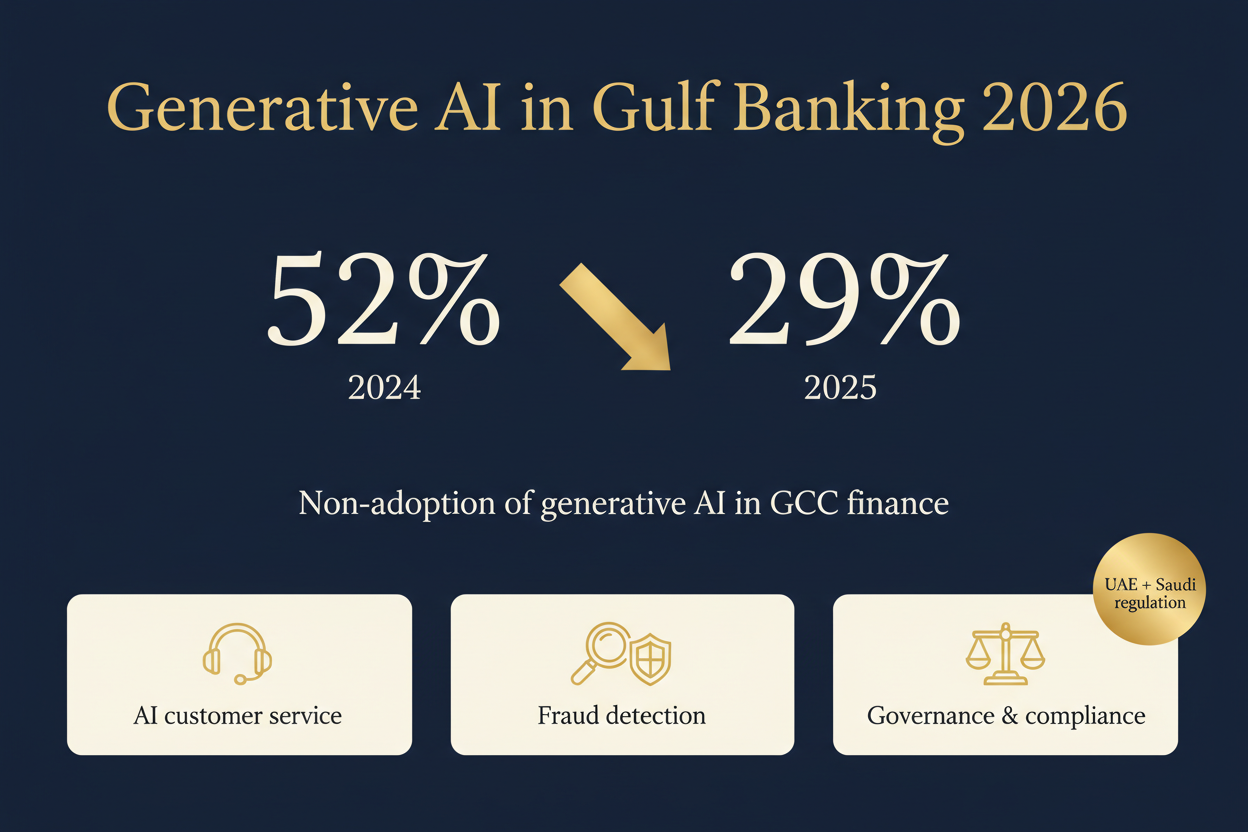
For two years, generative AI in Gulf banking lived in slide decks and pilots. In 2026 that changed. The technology is now in production across the region's largest institutions — and the thing that unlocked it was not a better model, but regulatory clarity.
The adoption curve just bent
The numbers tell the story of a fast catch-up.
- Across the GCC, non-adoption of generative AI in tax and finance functions fell from 52% in 2024 to 29% in 2025, according to a Deloitte survey.
- Globally, banks now run generative AI at enterprise scale, and Gulf institutions are closing the gap quickly rather than trailing it.
- The prize is material: generative AI could add an estimated $21–35bn a year across the GCC, on top of the roughly $150bn expected from other AI. McKinsey puts the global banking value of generative AI at $200–340bn annually.
Regulation was the real unlock
The blocker was never ambition. It was uncertainty about what supervisors would allow. Two moves removed it.
- The Central Bank of the UAE issued responsible-AI guidance in February 2026, built on five principles: governance and accountability, fairness, transparency and explainability, human oversight, and data management. It introduced the idea of a high-impact decision — any AI-driven determination affecting a customer's access to credit, pricing or claims — and gave customers the right to a human review.
- In Saudi Arabia, SDAIA updated its generative-AI guidelines through 2025, and the Kingdom declared 2026 the Year of AI.
With the rules written, procurement stopped stalling.
Where it is already live
This is no longer theoretical.
- Customer service: Emirates NBD's assistant Eva, Qatar Islamic Bank's bilingual Zaki, and Saudi National Bank's assistant handling Arabic, English and Urdu.
- Risk and compliance: real-time fraud detection, anti-money-laundering screening and credit scoring.
- Internal productivity: Emirates NBD is piloting Microsoft 365 Copilot and GitHub Copilot X for its own teams.
In June 2026, Emirates NBD and First Abu Dhabi Bank topped the Evident AI Index for the Middle East and Africa — a signal that Gulf banks are now benchmarked on responsible AI, not just adoption.
What to watch next
The next frontier is Arabic-native language models and agentic workflows that act, not just answer. The banks that win will be the ones that pair that capability with the governance the new rules now demand.
What this means for you
If your institution is still piloting, the gap to the leaders is now measured in months, not years. The winning move in 2026 is not a bigger model — it is a clear governance framework that lets you ship one.